In 2026, the question is no longer whether ChatGPT can write code.
It is whether that code can survive real users, increasing traffic, and more business pressure.
Founders test ideas faster than ever. Teams prototype in days instead of weeks.
But when apps move from concept to production, uncertainty creeps in.
So, where does ChatGPT actually fit in app building today, and where does expert-led mobile app development service still matter more than ever?
What App Building Looks Like in Real Life Today
Most businesses are not trying to build demo apps.
They want systems that handle growth, protect data, and deliver consistent experiences.
They want timelines they can trust and costs that do not spiral later.
Yet many teams start with excitement. ChatGPT generates screens, APIs, and even database logic. Early progress feels fast. That speed creates confidence.
Then real questions appear.
Who owns architecture decisions?
What happens when traffic spikes?
Who reviews security before launch?
Who will maintain the app six months later?
This is where the gap becomes visible. Code generation solves the starting point. It does not solve ownership.
That realization leads naturally to the bigger question of why this topic has become so important now.
Why This Topic Matters More in 2026
AI assisted development is no longer experimental. It is mainstream.
Research from McKinsey shows that generative AI can improve developer productivity by 20 to 45%, especially for repetitive tasks like refactoring, documentation, and standard logic generation. These gains are real, and teams using AI responsibly are seeing faster output.
At the same time, Gartner predicts that by 2026, over 80 percent of enterprises will be using generative AI APIs or deploying AI enabled applications. This marks a structural shift in how software is built.
Speed is no longer the differentiator. Judgment is.
Security research adds another layer of urgency. Studies cited by Snyk and OWASP show that roughly 40% of AI-generated code snippets contain at least one security vulnerability when not reviewed by experienced engineers. These are not edge cases. They are common patterns repeated from training data.
Meanwhile, IBM’s Cost of a Data Breach Report highlights that organizations with high security system complexity experience breach costs 31.6% higher than those with low complexity.
Put together, these insights point to a single truth. AI changes how apps are built, but it does not remove the need for expertise.
That brings us to what ChatGPT can actually do well today.
What ChatGPT Can Realistically Help Build
Code generation for common features
ChatGPT performs well when tasks are structured and predictable.
It can generate authentication flows, CRUD operations, API integrations, and basic business logic. For early MVPs and internal tools, this can reduce setup time significantly.
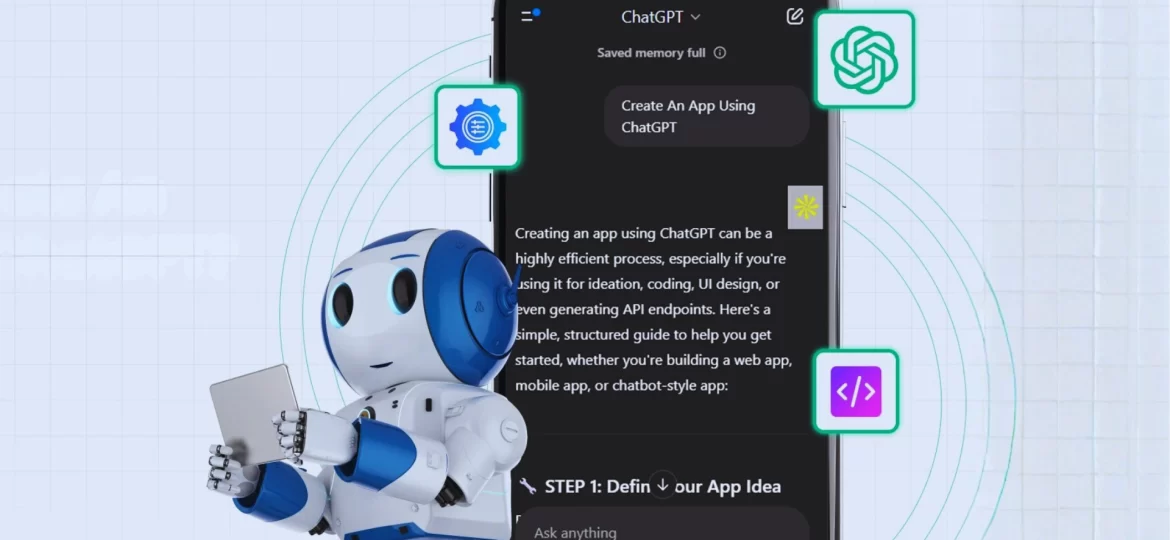
This is where ChatGPT app development shines. It accelerates momentum at the beginning.
The value lies in speed, not finality.
Prototyping and logic validation
Before development begins, teams often struggle to articulate workflows.
ChatGPT helps map user flows, edge cases, and validation rules. It acts as a thinking partner that surfaces gaps early.
This reduces rework later, especially when paired with experienced reviewers who understand product context.
Developer productivity support
GitHub research found that developers using AI assistants completed tasks 55.8 percent faster in controlled experiments. The key detail often missed is that the final code is still required to undergo human review before production use.
This is how modern mobile app development service teams use AI. Not as a replacement, but as a force multiplier.
As helpful as these capabilities are, they do not tell the full story.
Where AI App Development Tools Reach Their Limits
Architecture and scalability decisions
AI can suggest patterns, but it does not understand future business direction.
Scalability choices depend on expected growth, user behavior, and operational constraints. These decisions require accountability and foresight, not probability.
Once architecture is set, reversing it is costly.
Security and compliance responsibility
AI does not own risk.
Security is not just about fixing vulnerabilities. It is about designing systems that reduce exposure in the first place.
IBM’s research shows that automation and AI can save 1.88 million dollars in breach costs, but only when properly integrated into a broader security architecture. That integration requires human judgment.
Product thinking and user experience
Users do not behave like datasets.
AI can generate screens, but it cannot sense friction, emotion, or trust. Those insights come from real experience with real users.
This is where AI app development tools need human interpretation to avoid building features that look complete but fail in practice.
Long term maintenance and ownership
Apps evolve.
APIs change, platforms update, regulations shift. Someone must stay responsible for the system long after launch.
AI does not maintain accountability. People do.
This naturally leads to the model that works best in 2026.
The Model That Actually Works AI Plus Human Expertise
The most resilient teams do not choose between AI and developers. They design workflows where each plays its strongest role.
AI handles speed. Humans handle structure.
AI accelerates repetitive tasks. Humans make architectural calls.
AI suggests solutions. Humans validate risk.
AI generates code. Humans own outcomes.
This is how modern mobile app development service providers operate today.
AI reduces friction. Expert teams ensure clarity.
That balance protects long term value, which is why ignoring it leads to common mistakes.
Common Mistakes Businesses Make With AI-Built Apps
- Treating generated code as production-ready
- Skipping architecture reviews to save time
- Assuming security fixes can wait until later
- Believing AI removes the need for experience
- Launching without a maintenance strategy
Each of these decisions feels small early on. Over time, they compound into instability, higher costs, and lost trust.
Avoiding these mistakes does not require rejecting AI. It requires using it responsibly.
Which brings us to the final reflection.
ChatGPT can help you start faster. That part is undeniable.
But apps that scale, secure data, and support business growth still depend on accountable decision making.
The future belongs to teams that combine ChatGPT app development, intelligent AI app development tools, and expert led mobile app development service practices.
If you are building something meant to last, the question is not whether to use AI. It is how to use it without losing control.
If you want to explore what that balance looks like in practice, we are always open to thoughtful conversations.
FAQs
Can ChatGPT build a complete mobile app on its own in 2026?
It can generate large parts of an app, but it cannot fully replace expert oversight for architecture, security, and long term maintenance.
Is ChatGPT app development suitable for production apps?
It is suitable as a support tool, not as the sole builder of production systems.
How do AI app development tools help teams today?
They improve speed, reduce repetitive work, and support developers with suggestions and explanations.
Do businesses still need a mobile app development service?
Yes, especially for apps that handle real users, data, and growth.
What is the safest way to use AI in app development?
Combine AI speed with human accountability. Use AI to accelerate, not to decide.